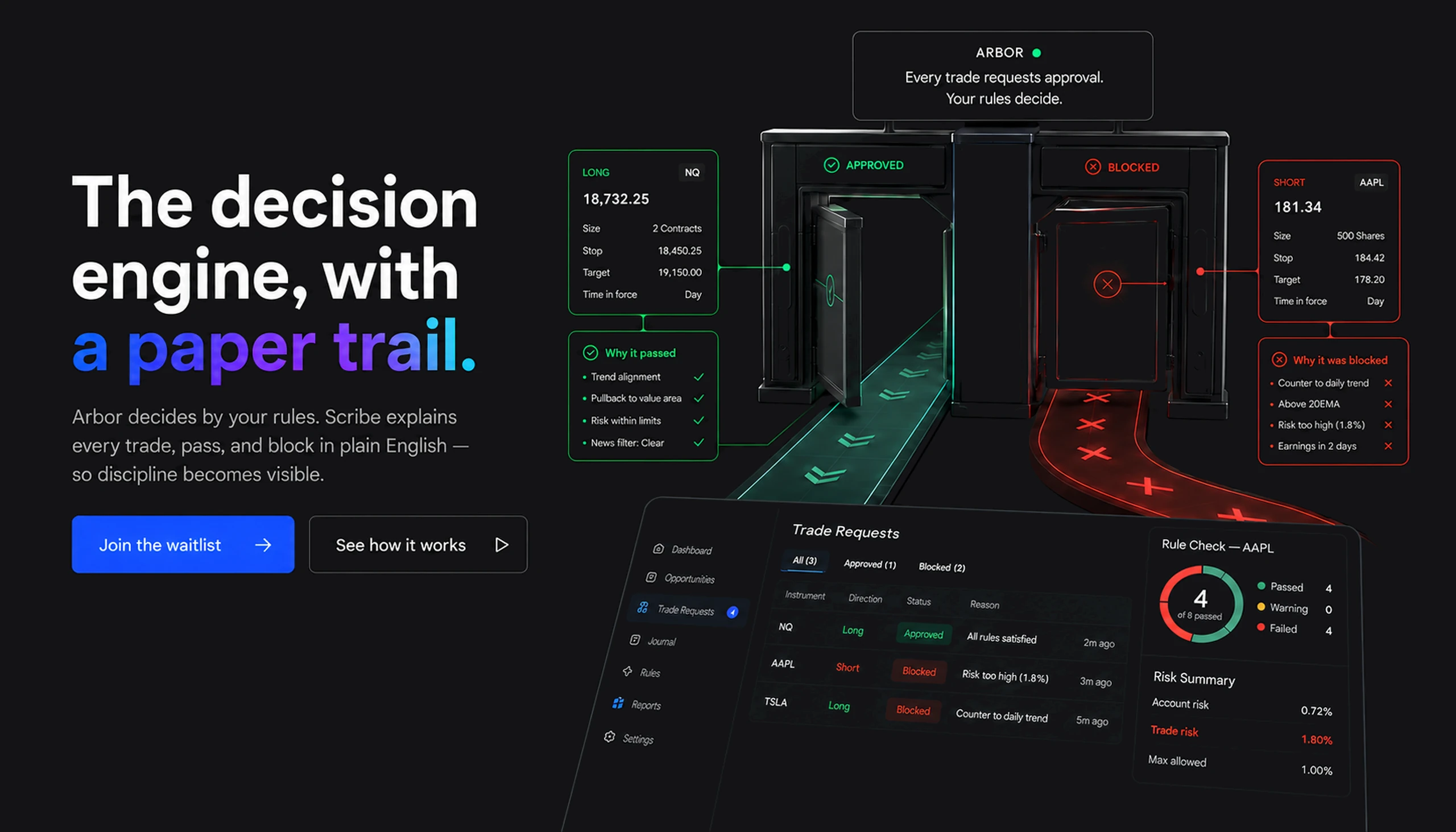
The decision engine, with a paper trail.
Arbor decides by your rules. Scribe explains every trade, pass, and block in plain English — so discipline becomes visible.
- Discipline first — rules over emotions
- Explainable by design — every action, in plain English
- Built for real markets — tested, transparent, trustworthy
 Join the waitlist
The decision
engine, with
a paper trail.
Arbor decides by your rules. Scribe explains every trade, pass, and block in plain English — so discipline becomes visible.
the cockpit
Most terminals open on a number.
This one opens on the reasons.
Your P&L tells you how the day went. It never tells you whether you deserved it. Prova leads with the four things that do — and every one of them is on screen before you place a single order.
- 1
Where the orders actually go
Mode, routing, armed — Auto · Paper · Running, in the strip, always. Never three panes deep in a settings sheet.
- 2
The limits you set, enforced
Exposure, daily loss, capital deployed, day-trade count. The app holds the line so your willpower doesn't have to.
- 3
The rule you're about to break
Trades, streak, cooldown. Cross a line you set and Arbor stops taking entries — a refusal, now, not a note in the post-mortem.
- 4
The regime you're actually in
Trending, ranging, high volatility — and which of your strategies has ever had an edge in it.
live
Watch it turn
a trade down.
Every other tool shows you a winner. Here is the one that matters — Arbor running the checks, finding three of them broken, and standing down, while Scribe tells you in plain English that this is the pattern your own record already calls revenge trading.
No black box. No trust the algo. The reason is right there — and it gets written down whether you like it or not.
- ✓EMA-21 reclaim
- ✓Volume confirms — 1.8x average
- ✓Risk guard — 0.8% of equity
- ✓Discipline — clear
scribe →
Every decision
recorded with the data behind it
Zero
trades the AI can place on its own
Your rules
the only thing Arbor will follow
the engine
Arbor decides.
Deterministic and unemotional. Arbor trades the rules you wrote — position sizing, risk guard, brackets, discipline checks — and nothing else. Dry-run and arm switches gate every live order. No black box, no “trust the algo.”
the voice
Scribe explains.
Every entry, every pass, every block — narrated in plain English at the moment it happens. Scribe can tell you why; it cannot pull a trigger. The AI is the voice of the system, never the hand.
the method
Most terminals are a toolbox.
This one is a loop.
A tool doesn't care what order you use it in. A method does. Prova is built in four steps, and they run in this order for a reason — the rules go in while you're calm, and the market gets to argue with them later.
DecideSet the rules while nothing is moving.
Risk limits, discipline guardrails, which strategies you'll run and when. Decisions made calmly, before there's a number on the screen arguing with you.
ExploreGo looking — inside the rules you just set.
Research, the scanner, the options chain. Prova will tell you what a symbol is doing and what it has historically done to you. It will never tell you to buy it.
TradeExecute, governed.
Every ticket shows Arbor's verdict before you commit: every limit you'd cross, your own record with that setup in this regime, and the refusal if one is coming.
ProveFind out whether any of it worked.
Every decision replayable, every refusal scored — including the trades you didn't make. Especially those.
The step everyone else skips is the last one. A terminal can tell you what you made. Only a record of what you refused can tell you what your discipline was worth.
inside prova
This is the product, not a pitch for it.
The only screen that speaks before the session does.
Every scheduled event ahead, graded by how much of it the market has already paid for — and what you’re holding into it, in dollars. “Heavily priced in” means a move needs a surprise, not just the event happening. Open the full read and it shows what actually followed the last twelve, dot by dot, with a note that twelve is a weak prior rather than a forecast.
Heavily priced in — 12 events of history, and you hold 4 positions worth $49,939
the record
It writes itself down.
Even the trades it refused.
Most tools only remember what you bought. Prova remembers what you were about to buy and shouldn’t have — then shows you the pattern, in your own numbers, before it costs you again.
the uncomfortable part
Every guardrail has a price.
No one else shows you the bill.
Every guardrail you set costs you something. A cap that stops a loser also stops a winner. A cooldown that saves you from revenge trading also makes you miss the re-entry. Every risk tool on the market sells you the upside of that trade and quietly never mentions the bill.
Prova follows every trade it refused you, settles it under the same stop and target it would have attached, and adds up what your discipline actually cost and actually earned — rule by rule, in your own money.
YOUR RULES, AUDITED
- Discipline 9
- +$1,240
- Per-order cap 11
- +$560
- Total exposure cap 8
- +$420
- Cooldown 6costing you money
- -$260
Cooldown is costing you money. Over 6 refusals it has cost you $260. Either the rule is wrong, or you're using it to skip trades you should be taking.
Any competitor could build this in an afternoon.
None of them will. Not because it's hard — the arithmetic is trivial — but because it means shipping software that tells a paying customer the feature they're paying for has lost them money.
No marketing department signs that off. So the moat here isn't code. It's nerve.
A tool that has never told you it was wrong has never told you anything.
And when the sums come out against us, the app says that too: “Had Arbor let you take everything it refused, the last 30 days would have ended at $3,810 — better than the $3,410 you actually made. Your rules were expensive this month.” That sentence is in the product. It has to be, or none of the others mean anything.
the rule
Green means measured.
Prova uses one colour for one thing. Green is only ever applied to a number that already happened — a closed trade, a settled counterfactual, a hit rate over a sample it will tell you the size of.
Nothing forward-looking is green. Not a target, not a projection, not a backtest. Those are drawn in neutral ink, because the app has no idea whether they will happen and colouring them would be a claim it can't support.
It is a small rule. It is also the reason you can trust the parts that are green.
on one real record
2 of 37 buckets cleared the bar.
Prova splits your closed trades six ways — by hour, by size, after a win, after a loss, by symbol, by setup, by regime — and then tells you how few of those splits mean anything. A pattern needs twenty trades and enough separation from zero before it gets a colour. Everything else stays grey and is labelled noise, however good the average looks.
Your own count will differ, and it climbs as your record grows. The point is that the app prints it at all. Most tools would show you thirty-seven findings.
The mark says the same thing. A blue stem for the trade, a purple branch where Arbor considers and converges, and one filled green dot at the end. Everything on the decision path is an open ring. Only the proof is solid.
A signal tool draws a line. A bridge pulls a trigger. A charting site shows a chart.
Prova tells you whether you should — and proves whether you were right.
Start on paper. Upgrade when it earns it.
The free plan runs the full Arbor engine, charts, replay, and the journal — enough to prove the system works before a dollar is at risk.